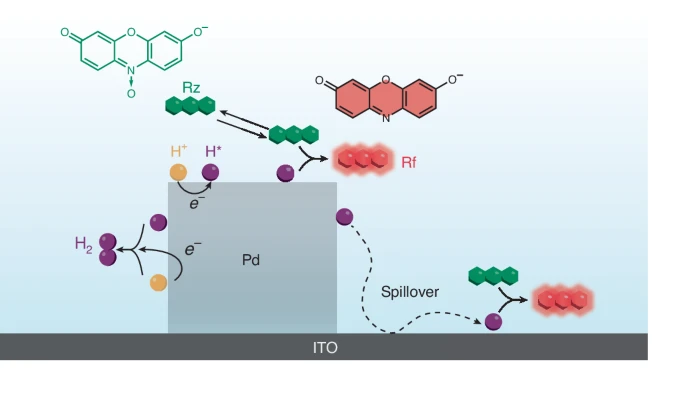
Many vital electrocatalytic transformations hinge on reactive surface metal–hydrogen intermediates (M–H), yet the low concentration and transient nature of such intermediates present formidable challenges to in-depth investigation. Here we use single-molecule super-resolution reaction imaging to directly probe surface palladium–hydrogen (Pd–H) intermediates on individual palladium nanocubes during electrocatalytic hydrogen evolution. Our approach visualizes hydrogen spillover from palladium to the surrounding substrate surface over hundreds of nanometres away and dissects substantial inter- and intraparticle heterogeneity. Through Gaussian-broadening kinetic analysis, we reveal that ensemble-averaged measurements systematically overestimate the stability of Pd–H*. Moreover, we resolve three subpopulations of palladium nanocubes with distinct reactivity features, uncovering critical correlations between intermediate stability, hydrogenation reactivity and transition-state properties. Our findings highlight the necessity of single-particle resolution for capturing the intrinsic complexity of electrocatalysts; our approach is also broadly applicable to interrogate surface-reactive intermediates across a wide array of electrocatalytic pathways.
In the News:
- A single-molecule view of surface Pd–H*, Nature Catalysis, 2025
- Breakthrough in Hydrogen Catalyst Research Using Single-Molecule, Engineeringness, 2025.